This article summarizes a talk that Teren CEO Toby Kraft gave at Enercom Denver August 20th, 2025.
A Tragic 4th
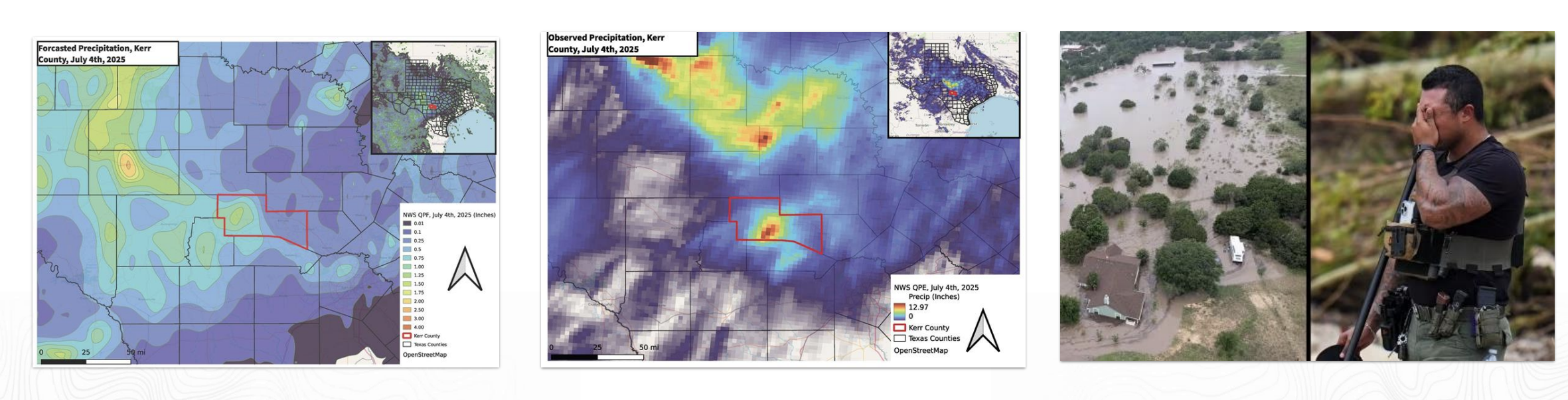
On July 4, 2025, communities in Texas Hill Country were blindsided by a 20-foot wall of water. In less than 90 minutes, a convective burst unleashed over 12 inches of rainfall – more than Denver’s annual average – causing catastrophic flooding along the Guadalupe River. The result: 138 lives lost and $18–22 billion in economic damages.
For operators of critical infrastructure, such as pipelines, power, water, and transportation systems, this wasn’t just a tragedy. It was a wake-up call.
What Went Wrong
The National Weather Service’s forecast the day before called for 2-4 inches of rain, with localized totals of 5-7 inches. But physics-based weather models, while scientifically rigorous, are computationally heavy and slow. They require coarse resolutions and six-hour update cycles, leaving communities and operators with narrow, fragmented windows for response.

In this case, the models didn’t anticipate the localized convective burst. Infrastructure owners downstream had no meaningful lead time to act.
And this isn’t an isolated problem. Over the past five years alone, the U.S. has endured $746.7 billion in extreme weather damages and 1,500+ lives lost. The stakes have never been higher.
Why AI Changes the Game
Enter artificial intelligence. Across 90% of measurable metrics, AI-based weather forecasting is already outperforming traditional physics-based models. Google’s GraphCast, for example, predicted Hurricane Lee’s landfall three days earlier than the best numerical models.
What makes AI so powerful for operators?
-
Speed: AI models run 100–1000x faster than physics-based ones, delivering near real-time updates.
-
Resolution: Hyper-local forecasts reach down to the neighborhood, road segment, or asset level.
-
Actionability: Probabilistic outputs help prioritize resources where they’re needed most.

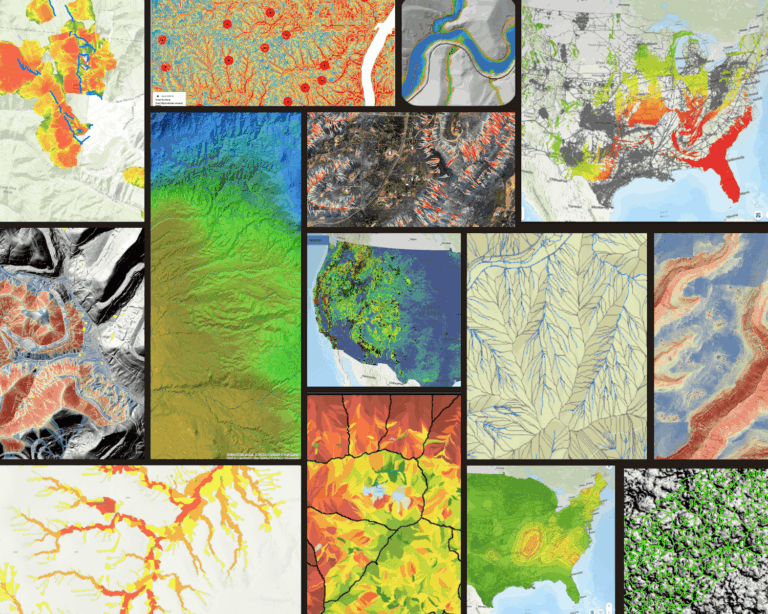
At Teren, we’ve built on these advancements to deliver Terevue, our environmental intelligence platform. Think of it as an environmental digital twin—a living, virtual representation of terrain, soils, weather conditions and their impacts to infrastructure.
The Next Frontier: AI + Flood Prediction
In addition to its ongoing predictive flood modeling, Teren is partnering to pioneer hybrid AI-physics flood models. These will integrate AI weather forecasts with terrain, soil saturation, and flow dynamics to deliver:

-
Street-level flood predictions in near real-time.
-
Hours to days of additional lead time for operators, responders, and communities.
-
Asset-specific intelligence so infrastructure managers can harden systems before disaster strikes.
This work, sponsored by major energy companies, reflects a broader shift: resilience isn’t just an operational need – it’s a public good.
A Safer Future
“The storms of the future are inevitable, but the tragedies are not,” is how Toby closed his Enercom Denver 2025 talk:
With AI-driven environmental intelligence, infrastructure operators no longer have to react blindly to nature’s curveballs. They can:
- See risks sooner
- Act with precision
- Protect people, assets, and communities
And in doing so, they not only save millions in avoided losses; they also deliver on their duty of care to the public.