
From Dry Slopes to Disaster Zones: Why Landslide Modeling Needs a Rain Check

When do landslides actually happen? Not when the slope is steep—but when it’s steep, saturated, and pushed past its tipping point. And yet: most landslide models in use today ignore that final push. They tell us where landslides might occur based on slope and soil—but not when. And that omission is what leaves so many […]
From Tragedy to Resilience: How AI is Transforming Disaster Management
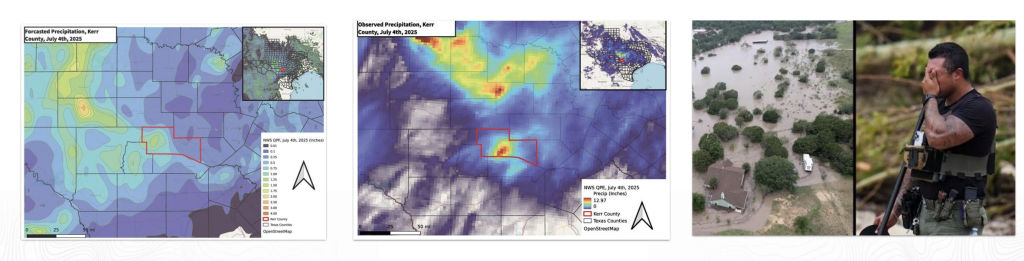
This article summarizes a talk that Teren CEO Toby Kraft gave at Enercom Denver August 20th, 2025. A Tragic 4th On July 4, 2025, communities in Texas Hill Country were blindsided by a 20-foot wall of water. In less than 90 minutes, a convective burst unleashed over 12 inches of rainfall – more than Denver’s […]
What Makes a Good Hazard Model for Critical Infrastructure Operations? 6 Questions to Ask

Hazard models are everywhere, from FEMA flood maps to state landslide inventories to national wildfire indices. But not all models are created equal. For infrastructure operators (be it pipelines, utilities, transportation, renewables and beyond), integrity engineers, and damage prevention teams, these models directly influence decisions on where to deploy crews, how to prioritize integrity management […]
No More Data for Data’s Sake: Cutting Through Pipeline Data Clutter

Pipeline operations and integrity teams are inundated with data. From LiDAR scans and IMU readings to photogrammetry, satellite imagery, and weather feeds, the volume of incoming information can feel paralyzing. As one panelist at Teren’s recent Operator discussion on weather and external force threats put it, the real challenge isn’t always a lack of data—it’s […]
Death by Average: Why “100-Year” Floods and Landslides Keep Happening, and Average Risk Models Are Failing Us

If you feel like “100-year” floods are happening every few years, you’re not imagining things. The problem isn’t just the climate—it’s the math. For decades, engineers and emergency managers have relied on recurrence intervals like the “100-year flood” to describe the likelihood of natural disasters. But as extreme weather events grow more frequent and destructive, […]
Introducing Terevue Geotech Module: Predictive Insight for Landslide Risk

Pipeline operators, asset managers, and environmental engineers are under growing pressure to monitor and manage geotechnical hazards like landslides. Dormant threats can awaken with a single downpour, and policies such as PHMSA CFR 192.613 and ADB-2022-01 are now clear: pipeline operators must move beyond reactive responses and demonstrate proactive, risk-based management before severe weather turns […]
From Overwhelmed to In-Control: A New, Smarter Framework for Pipeline Natural Force Threat Management

If you work in pipeline operations, you’ve likely felt the pressure of rising expectations—from regulators, customers, and your own team. The reality is that more data doesn’t always mean more clarity. It often means more noise, more confusion, and more liability. That’s why Teren created the Terevue Awareness to Action Framework—a 3 tier, risk-based approach […]
Drowning in Uncertainty: 4 Ways Traditional Flood Models Fail Modern Infrastructure

Floods don’t wait for paperwork—and they definitely don’t care about boundaries on a decades-old map. But across the critical infrastructure industry, many asset managers are still forced to rely on outdated flood tools like FEMA maps and USGS gauges to plan for hydrologic risk. Here’s why that’s a problem—and what can be done about it. […]
Introducing Terevue Hydrotech: Real-time Flood and Scour Risk Intelligence for Pipeline Operators

Flooding doesn’t wait for maps to be updated. Yet too many asset managers and operators are still relying on legacy flood tools that were never built for today’s extreme weather—or the critical infrastructure they threaten. That’s why Teren is proud to introduce the Hydrotech Module—the latest addition to the Terevue Platform, purpose-built to help pipeline […]
How a Rain Event Validated Terevue’s Accuracy in Predicting Landslide Threats
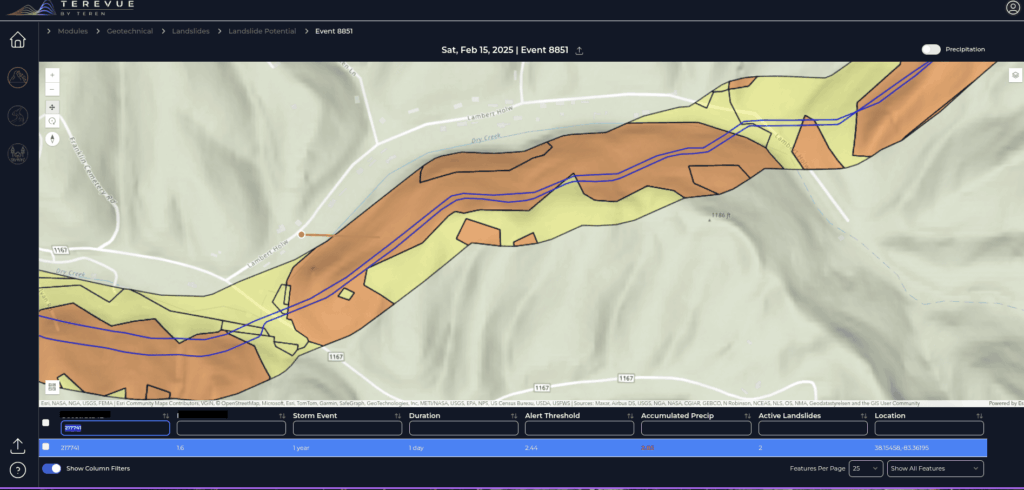
One operator’s experience proved that Terevue can catch the risks no patrol or instrument might see—until it’s too late. The Challenge Pipeline operators face an uphill battle when managing assets in landslide-prone regions. With limited instrumentation like inclinometers, most rely on aerial patrols and historical data to detect potential threats. But with traditional methods, not […]